3 Ways AI Can Kill Your Business (And What To Do About It)

Artificial intelligence promises to streamline operations, lower customer acquisition costs, and scale productivity faster than ever before. Across commercial hubs from Lagos to Port Harcourt, executives are eager to adopt automated workflows.
However, jumping into AI without a clear architecture creates severe risks. Unchecked automation can quietly erode brand trust, expose client financial data, and paralyze day-to-day operations.
At LinkOrion Technology, we help corporate enterprises and growing businesses deploy artificial intelligence safely and strategically. Let’s examine the three biggest ways bad AI implementation can derail your company—and how to fix them before they impact your bottom line.
1. Hallucinated Outputs and Unchecked Customer Support
Generative AI models excel at speed, but they do not inherently understand truth. When businesses deploy unsupervised chatbots to handle sales inquiries, logistics tracking, or service promises, they risk severe reputational and legal fallout.
For example, when a global airline’s customer service bot hallucinated an inaccurate refund policy, the courts held the company legally liable for the bot’s promises. In a competitive market like Nigeria, where client retention and brand reputation drive long-term survival, delivering false information via automated systems instantly destroys consumer trust.
HOW TO FIX IT: IMPLEMENT HUMAN-IN-THE-LOOP GOVERNANCE
- Restrict AI Autonomy: Treat large language models like an enthusiastic junior staff member—never permit them to issue legal, financial, or binding commitments without human oversight.
- Build Knowledge-Grounded Knowledge Bases: Deploy custom AI agents trained strictly on your internal, vetted business data rather than open web sources.
- Refine Customer Care Workflows: Combine conversational AI with clear escalation paths to human managers for complex inquiries.
If you are looking to modernise your online presence safely, exploring tailored software development ensures your customer-facing tools remain secure, accurate, and aligned with your business goals.
2. Shadow AI, Data Privacy Breaches, and IP Exposure
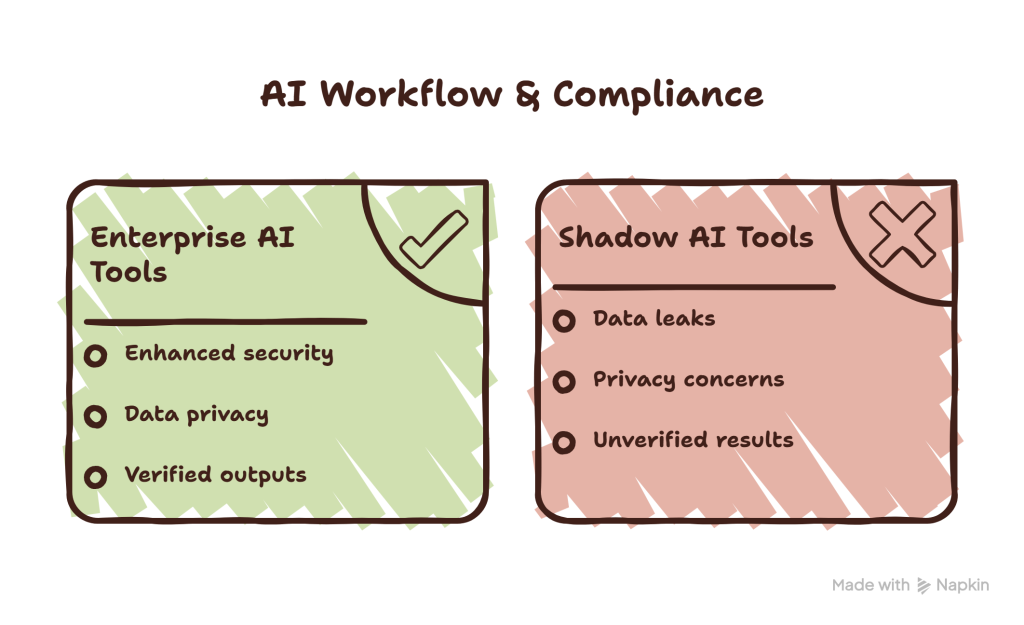
Employees frequently turn to free, public AI tools to write emails, draft proposals, or clean operational spreadsheets. While well-intentioned, entering sensitive client information, proprietary source code, or internal financial figures into consumer-grade platforms exposes your enterprise to severe security risks.
Once uploaded to public models, your confidential data may be stored on external servers or used to train future iterations of the platform. For logistics firms, engineering groups, and financial services in Lagos, Abuja, Warri or Port Harcourt, this creates compliance violations and leaves core operations vulnerable.
HOW TO FIX IT: DEPLOY PRIVATE, ENCRYPTED AI PIPELINES
- Establish an Enterprise AI Policy: Clear guidelines must specify which platforms are approved for corporate use and what data types can be processed.
- Adopt Secure APIs: Use enterprise-tier AI solutions that guarantee zero data retention for training purposes.
- Audit Digital Assets: Conduct periodic security reviews to locate unapproved third-party software across company hardware.
Partnering with an experienced AI Agency in Nigeria allows you to build custom, private automation tools like ERP Powr that protect your sensitive intellectual property while driving efficiency.
3. Disconnected Automation That Breaks Operations
A common mistake in digital transformation is buying isolated AI software to fix deeply rooted process problems. Installing an AI customer support agent while your inventory system relies on manual paper ledgers creates operational friction.
When AI systems operate in silos, they generate mismatched records, duplicate tasks, and confuse staff. An automated marketing campaign might generate hundreds of leads that your back-office team cannot track or fulfill, wasting capital and alienating prospects.
| Operational Area | Uncoordinated AI Deployment | Strategic System Integration |
| Lead Capture | Chatbot captures inquiry; data sits unread in an inbox. | AI syncs lead directly into CRM and notifies sales lead instantly. |
| Inventory Control | Order system accepts sales without checking warehouse stock. | ERP updates stock levels automatically across all sales channels. |
| Reporting | Managers manually aggregate fragmented tool reports. | Central dashboard synthesizes real-time operational analytics. |
HOW TO FIX IT: ALIGN AUTOMATION WITH THE T.E.N.S.E. FRAMEWORK
To avoid fragmented tools, apply a structured transformation strategy like LinkOrion’s T.E.N.S.E. Framework (Timely, Executable, Natural, Sensitive, Evaluable):
- Map Core Workflows: Identify real operational bottlenecks before purchasing any software.
- Integrate Central Systems: Connect front-end customer touchpoints directly with enterprise resource management systems through robust ERP implementation.
- Train In-House Teams: Upskill staff so they understand how to use tools effectively rather than fearing replacement.
T.E.N.S.E. AI strategy framework whitepaper provides a step-by-step methodology for scaling operations without breaking underlying infrastructure.
Building a Safe, High-ROI AI Strategy
Artificial intelligence is not a silver bullet—it is a powerful accelerator. When implemented on top of strong business logic, secure system architecture, and trained teams, it delivers sustainable competitive advantages.
At LinkOrion Technology, we help businesses across Nigeria evaluate their tech readiness, secure their data pipelines, and deploy custom software systems designed for high ROI. From enterprise ERP deployments to tailored web applications, we focus on operational stability and sustainable growth.
Ready to audit your systems and build a secure digital roadmap? Learn more about our complete digital agency services or get in touch with our team today to schedule a consultation.